The Tempest
The Tempest is Shakespeare's enchanting final masterpiece, blending magic, revenge, and redemption on a mysterious island. This guide equips you with the analytical tools to explore its complex characters, colonial themes, and beautiful language for top marks.
Study Notes
Overview

The Tempest is widely considered Shakespeare's final solo play (c. 1610-1611). It offers a rich tapestry of magic, power, and colonialism, culminating in a powerful message of forgiveness. Examiners look for a nuanced understanding of Prospero's moral ambiguity, the post-colonial implications of Caliban's enslavement, and Shakespeare's use of the island as a symbolic space where normal rules are suspended.
Podcast
Listen to our comprehensive 10-minute revision podcast covering plot, themes, and exam technique:
Plot/Content Overview
Act 1: A violent storm (tempest) wrecks a ship carrying Alonso (King of Naples), his son Ferdinand, and Antonio (Prospero's usurping brother). Prospero reveals to his daughter Miranda that he caused the storm using magic. He recounts how Antonio usurped his dukedom 12 years ago. We meet Ariel, Prospero's spirit servant, and Caliban, the enslaved island native.
Act 2: The shipwreck survivors are scattered. Alonso mourns Ferdinand, believing him dead. Antonio and Sebastian plot to murder Alonso. Elsewhere, the jester Trinculo and drunken butler Stephano encounter Caliban, forming a comedic but dangerous subplot.
Act 3: Ferdinand and Miranda fall in love, though Prospero tests Ferdinand with hard labour. Caliban, Stephano, and Trinculo plot to murder Prospero. Ariel, disguised as a harpy, confronts Alonso, Antonio, and Sebastian with their past crimes.
Act 4: Prospero blesses Ferdinand and Miranda's betrothal with a magical masque. He suddenly remembers Caliban's plot and abruptly ends the celebration. Ariel leads the drunken conspirators into a swamp.
Act 5: Prospero has his enemies at his mercy but chooses forgiveness over revenge ("The rarer action is in virtue than in vengeance"). He renounces his magic, breaking his staff and drowning his book. The ship is revealed to be safe, and Prospero prepares to return to Milan.
Themes
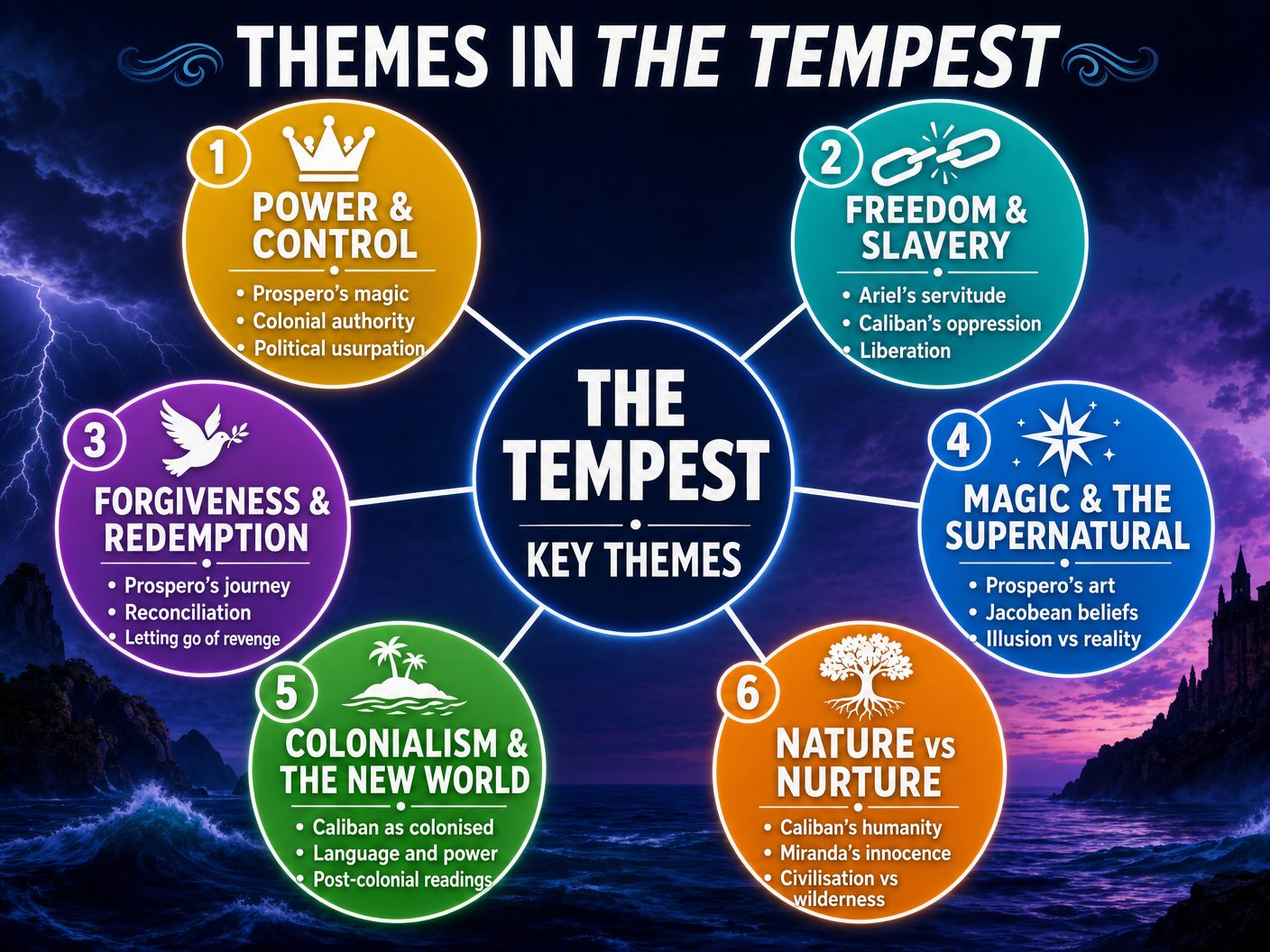
Theme 1: Power and Control
Power in The Tempest is multifaceted: political, magical, and colonial. Prospero's magic is an instrument of control, mirroring the political power he lost in Milan. He controls Ariel through promises and Caliban through pain. The play questions the legitimacy of authority and the line between ruler and tyrant.
Key Quotes:
- "This island's mine, by Sycorax my mother, / Which thou tak'st from me." (Act 1, Scene 2) - Caliban asserts indigenous rights against Prospero's colonial power.
- "I must obey: his art is of such power" (Act 1, Scene 2) - Caliban acknowledges the absolute nature of Prospero's magical control.
Theme 2: Freedom and Slavery
The desire for freedom drives the narrative. Ariel serves willingly but impatiently awaits liberty. Caliban is enslaved by force and rebels. Even Ferdinand is temporarily enslaved by Prospero to test his love for Miranda. Shakespeare contrasts different responses to subjugation.
Key Quotes:
- "You taught me language, and my profit on't / Is, I know how to curse." (Act 1, Scene 2) - Caliban highlights how the 'gift' of civilisation is merely a tool of oppression.
- "My liberty." (Act 1, Scene 2) - Ariel's constant refrain and ultimate goal.
Theme 3: Forgiveness and Redemption
The play's structure moves from vengeance towards reconciliation. Prospero spends 12 years nursing his grievances, yet when absolute revenge is possible, he chooses grace. This reflects Jacobean Christian values and Renaissance humanism.
Key Quotes:
- "The rarer action is / In virtue than in vengeance" (Act 5, Scene 1) - Prospero's pivotal realisation, prompted by Ariel's pity.
- "I do forgive thee, / Unnatural though thou art." (Act 5, Scene 1) - Prospero forgives Antonio, though Antonio's silence suggests he may not be truly repentant.
Character Analysis
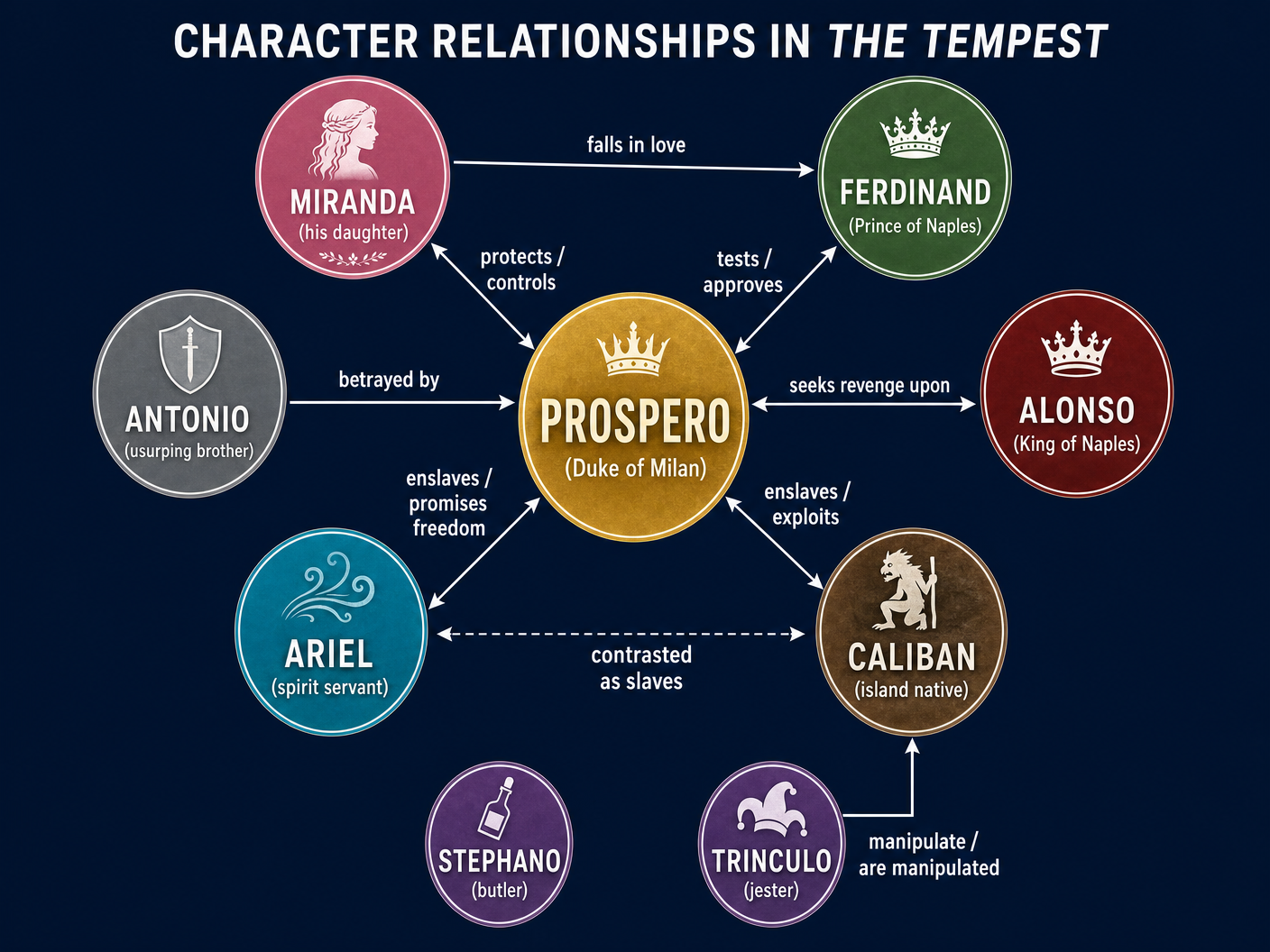
Prospero
Role: The protagonist, rightful Duke of Milan, and master of magic.
Key Traits: Controlling, protective, learned, ultimately forgiving but morally ambiguous.
Character Arc: Moves from a desire for absolute revenge to a realisation of shared humanity and the necessity of forgiveness. He renounces his supernatural power to rejoin human society.
Essential Quotes:
- "We are such stuff / As dreams are made on, and our little life / Is rounded with a sleep." (Act 4, Scene 1)
- "I'll break my staff... I'll drown my book." (Act 5, Scene 1)
Caliban
Role: The enslaved native of the island.
Key Traits: Earthy, resentful, poetic, physically deformed but emotionally complex.
Character Arc: Begins as a rebellious slave, seeks a new master in the foolish Stephano, but ultimately realises his folly and seeks grace.
Essential Quotes:
- "Be not afeard; the isle is full of noises, / Sounds and sweet airs, that give delight and hurt not." (Act 3, Scene 2) - Reveals his deep connection to the island and his capacity for beautiful poetry.
- "A thing of darkness I / Acknowledge mine." (Act 5, Scene 1) - Prospero's final assessment of Caliban, acknowledging responsibility.
Ariel
Role: An airy spirit, bound to serve Prospero.
Key Traits: Ethereal, obedient, empathetic, desperate for freedom.
Character Arc: Executes Prospero's will flawlessly, ultimately teaching Prospero the value of human pity, before finally achieving liberty.
Essential Quotes:
- "Mine would, sir, were I human." (Act 5, Scene 1) - Ariel's profound statement that prompts Prospero's forgiveness.
Writer's Methods
- Blank Verse vs. Prose: Shakespeare uses iambic pentameter (blank verse) for noble characters and elevated themes, and prose for the comedic, lower-class characters (Stephano, Trinculo). Crucially, Caliban often speaks in beautiful blank verse, elevating his status and highlighting his innate humanity.
- Dramatic Structure: The play adheres strictly to the classical 'unities' of time, place, and action. The events occur in real-time (roughly three hours) on a single island, intensifying the dramatic pressure.
- The Masque: The magical pageant in Act 4 is a 'masque' — a form of courtly entertainment popular in King James I's court. It celebrates order, fertility, and marriage, contrasting with the chaotic storm of Act 1.
Context
- Colonialism and the 'New World': Written during the early years of English colonisation of the Americas (e.g., the Jamestown settlement). Reports of shipwrecks in Bermuda heavily influenced the play. Caliban (an anagram of 'cannibal') represents European anxieties and projections about indigenous peoples.
- Magic and Religion: King James I was fascinated by the supernatural and wrote Daemonologie. Prospero's magic is 'theurgy' (learned, intellectual magic), contrasted with the 'goety' (black magic) of Caliban's mother, Sycorax. Yet, Prospero must ultimately renounce it to be fully human.
- Renaissance Humanism: The belief in the potential of human beings to master nature through knowledge and reason, embodied by Prospero's study of his books.
Visual Resources
2 diagrams and illustrations
Interactive Diagrams
1 interactive diagram to visualise key concepts
Conceptual Flow Outline
Prospero's Character Arc: From Vengeance to Grace
Worked Examples
2 detailed examples with solutions and examiner commentary
Practice Questions
Test your understanding — click to reveal model answers
Explore how Shakespeare presents the relationship between Prospero and Ariel. (30 marks + 4 AO4)
Hint: Consider the power dynamic, Ariel's desire for freedom, and how Ariel influences Prospero's moral choices at the end of the play.
How does Shakespeare present the island as a place of magic and transformation? (30 marks + 4 AO4)
Hint: Look at how different characters perceive the island. To Gonzalo it is lush, to Antonio it is barren. Look at how the island changes people.
Starting with this extract (Act 3, Scene 2: Stephano, Trinculo, and Caliban), explore how Shakespeare presents the comedic characters in the play. (30 marks + 4 AO4)
Hint: Don't just say they are funny. Explain how their foolish plot to overthrow Prospero mirrors the serious political treason of Antonio and Sebastian.
Explore the presentation of Miranda and her relationship with her father. (30 marks + 4 AO4)
Hint: Look at her innocence, her empathy, but also how Prospero uses her as a political pawn in his master plan.